




How to Read Ingredient Labels for Personal Care

Most lotions are mostly water. You can prove that in about four seconds, without knowing a single chemical name.
Ingredients on a personal care label are listed in descending order by amount. The first ingredient is present in the greatest quantity; the last is present in the least. Water appears first in most lotions because most lotions are mostly water. Shea butter appears first in a body butter because shea butter is mostly what it is. That structure is not an accident. It is the point.
Most people go straight to the front of the package, where the adjectives live, and miss the only part of the label that's actually regulated. Once you know the order rule, a label stops being a wall of text and starts being a ranked list. You don't need a chemistry degree to use it.
You need about two minutes and a willingness to read the first five entries before you decide anything else.
The Order Rule
The descending-order requirement comes from 21 CFR 701.3, the federal regulation governing cosmetic labeling in the United States. It means the first five ingredients tell you what a product mostly is. If a label opens with water, glycerin, and a synthetic polymer, that product is mostly water, glycerin, and a synthetic polymer, regardless of what the front of the package says. If it opens with shea butter and coconut oil, those are the dominant materials.
Predominance is measured by weight at the time of manufacture, not by how a product feels or performs. A silky texture doesn't mean the silkiest-sounding ingredient is at the top. The weight is what determines position. That surprises people, because nutrition labels train you to read differently. The rule is consistent: weight at manufacture sets the order.
One practical note: below the 1% threshold, the order rule stops carrying meaningful weight. Under 21 CFR 701.3(f)(2), ingredients present at a concentration not exceeding 1% may be listed in any order after the ingredients present at more than 1%. Don't over-read the small-print tail of a long list. The signal is in the first five entries, not the last fifteen.
A longer ingredients list isn't automatically worse. But a short list is faster to audit in a minute, standing in the aisle. Scan the first few ingredients on any bottle before you buy.
You don't need to recognize every name yet. Just ask: what is this product mostly made of? That single question, applied to the top of the list, gives you more useful information than anything printed on the front of the package.
What to know about "Fragrance"
The word "fragrance" or "parfum" on a label is a single entry that can represent dozens of undisclosed components. Why? Because fragrance formulas are treated as trade secrets under the same regulatory framework that governs cosmetic labeling. As the FDA's cosmetics labeling guide notes, fragrance and flavor compounds may be declared as "fragrance" and "flavor," and the components of a fragrance may also be declared individually by their appropriate label names, but they don't have to be.
Humble's own deodorant labels list "fragrance," and the reason is space. A scent like Mountain Lavender uses a single essential oil; Rockrose & Cedar uses ten, and a full list won't fit on every label. Every Humble deodorant label denotes our fragrances are derived from essential oils and botanical extracts on the label and a full ingredient list for each scent, with every oil named, is on product pages on humblebrands.com.
What that means practically: two products can both list "fragrance" and contain very different formulas, since the word itself carries no information about contents. One might use a handful of botanical extracts. Another might use a complex synthetic blend.
The Latin Names
Butyrospermum parkii is shea butter. Olea europaea is olive oil. The Latin names on a personal care label follow INCI, the International Nomenclature of Cosmetic Ingredients, a global naming standard that gives every ingredient one consistent name regardless of where a product is sold. It exists so that an ingredient means the same thing on a label in Germany, Japan, and the United States. It is not a way to disguise a plant as a chemical.
The FDA requires ingredients to be listed by their common or usual names under the Fair Packaging and Labeling Act. As the FDA notes, "cosmetic companies sometimes ask FDA about identifying botanicals only by their Latin names. Under the FPLA, however, ingredients must be listed by their 'common or usual names,' and FDA does not accept these alternatives as substitutes."
A short, practical habit: search the Latin name plus "INCI," and you'll typically get a plain-English match for the plant or compound behind it in under a minute. Cocos nucifera is coconut oil. Persea gratissima is avocado oil. Still just the plant.
A long Latin name is a naming convention, not a disguise. A quick search turns it into something readable before you've left the aisle. Once you've looked up a dozen or so common ones, you'll start recognizing them on sight without needing to search at all.
Front-of-pack Words: Facts Versus Decoration
"Natural," "clean," and "pure" are not meaningfully regulated in personal care. They can mean anything, which means they mean nothing. List what's in, list what's out, let the reader read. A claim you can check beats an adjective you have to trust.
The contrast is worth stating plainly. INCI names and the order rule are regulated facts a shopper can verify. "Clean," "natural," and "pure" are marketing language with no enforced legal definition in this category. The FDA has confirmed that it does not have a list of approved or accepted claims for cosmetics, and the law does not require cosmetic labeling to have FDA approval before products go on the market.
A quick gut-check: if a claim on the front of the package can't be traced to something specific on the ingredient list, treat it as decoration, not information. "Made with botanicals" means nothing if the first five ingredients are synthetic. "Free from parabens" is checkable: look at the list and confirm parabens aren't there. That second type of claim earns its place. The first type is just noise.
What is regulated on the front of pack, for contrast: net weight, the ingredient declaration itself, and any drug-fact claims. Drug claims trigger a different, stricter set of rules entirely. Everything else, the adjectives and the lifestyle language, is largely unregulated. The ingredient list is where the facts live.
FAQs - How To Read Ingredient Labels
Are Ingredients Really Listed by Amount?
Yes, for ingredients present above 1% by weight. Federal regulation requires that cosmetic ingredients be listed in descending order of predominance, so the first ingredient is present in the greatest quantity. Below 1%, ingredients may appear in any order, which is why the tail end of a long ingredients list carries less positional meaning than the top.
What Does "Fragrance" or "Parfum" on a Label Mean?
It means something is creating a scent, but the label isn't required to say what. Fragrance formulas are treated as trade secrets, so a single word can represent a proprietary blend of many components. Always check to see if there’s additional information in the label notes on what it’s derived from.
Is "Natural" a Regulated Claim?
No. In personal care, "natural" has no enforced legal definition. The FDA does not maintain a list of approved cosmetic claims, and brands are not required to prove a product meets any standard before using the word. The ingredient list is the only place where regulated, verifiable information lives.
What Does INCI Stand For?
INCI stands for International Nomenclature of Cosmetic Ingredients, the global naming standard that gives every ingredient one consistent name regardless of where a product is sold. It's why you see Latin botanical names on labels: those names are the recognized international standard, not an attempt to obscure what's inside.
Is a Longer Ingredient List Worse Than a Short One?
Not automatically. Order and disclosure matter more than length. A long list with named oils, no "fragrance" entry, and recognizable ingredients at the top can be more transparent than a short list with vague entries. A short list is just faster to read in full, which is why it's easier to audit quickly in the aisle.
Read the Label. Then Read Anyone Else's.
The four checks above take about two minutes on any label. Order. Fragrance. INCI names. Front-of-pack words. You don't need to memorize ingredient chemistry. You need to know where the regulated facts are and where the marketing language lives. Now the aisle will stop feeling like a guessing game and start feeling like a conversation you know how to have. That's the shift.
Humble publishes a full Ingredient Index that names every ingredient, explains its source, and states its purpose.
-
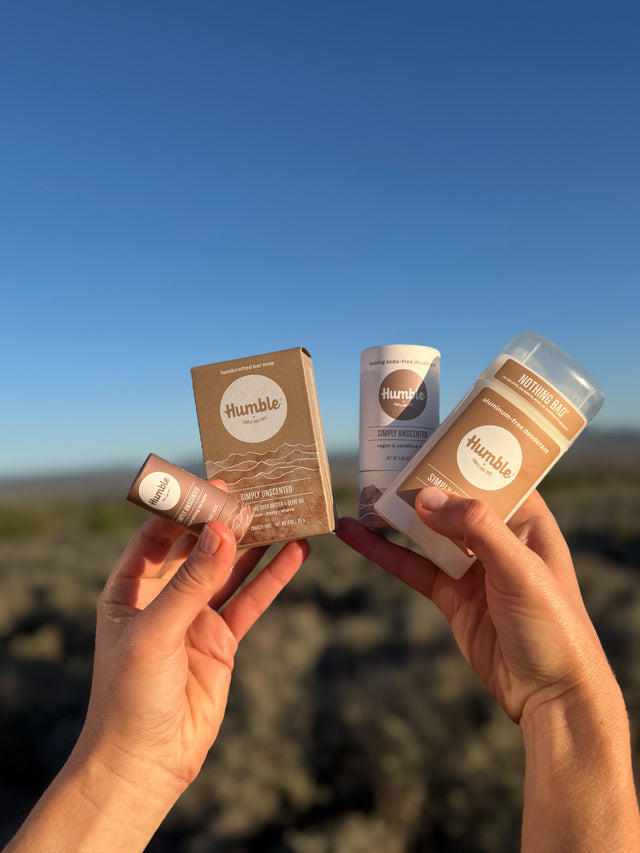
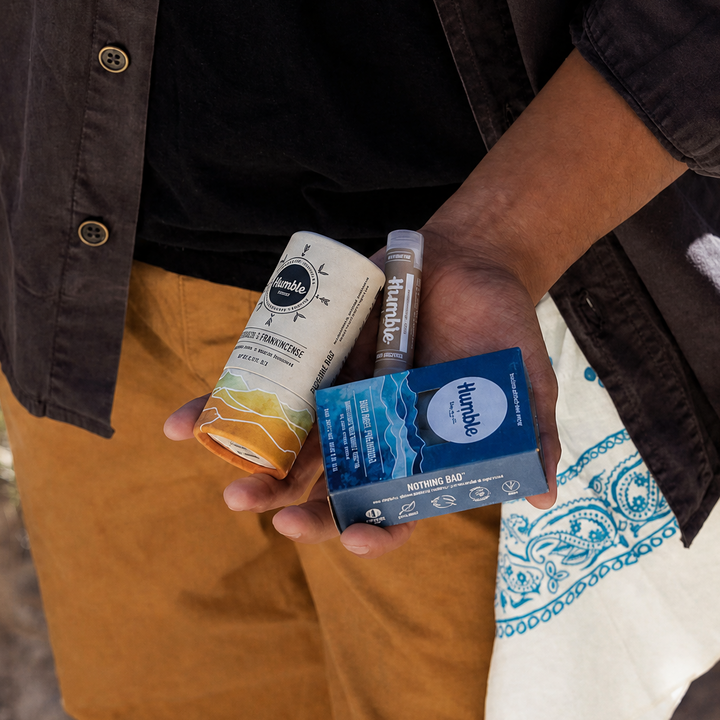
Humble's aluminum-free deodorant lists four base ingredients plus essential oils, made in Taos, New Mexico.
-
The bar soap uses plant-based whole oils, shea butter, and olive oil.
-
The lip balm uses butters and essential oils. Every list is short enough to read while standing at the shelf.
That's the standard. Hold every label to it.
Related Reads


Most loved
Shop bestsellers

- Grounding
PLASTIC FREE DEODORANT
Black Spruce Plastic-Free Deodorant
$12.99
Scent intensity: 4/5


Leave a comment
Please note, comments must be approved before they are published