




How to Choose the Best Deodorant for Sensitive Skin

You've already been through this once. You picked up a natural deodorant that looked clean, gave it a week, and ended up with redness, itching, or a rash that took longer to clear than the product did. Now you're back at the beginning, scanning ingredient lists and reviews before you commit again. That's not overcaution. That's the right instinct.
The problem isn't that sensitive skin can't tolerate natural deodorant. The trick is knowing how to evaluate a formula rather than trusting its marketing claims.
You need an evaluation framework: what to screen out before you compare formulas, which ingredients earn their place, how to match a formula to your specific sensitivity type, and a patch-test method to confirm the fit before you commit to a full-size product.
What "best for sensitive skin" actually means?
The best deodorant for sensitive skin isn't the strongest one on the shelf. It's the one built from the fewest ingredients that can cause a reaction in the first place.
A formula can be aluminum-free and cruelty-free and still irritate reactive skin if it contains hidden fragrance or a high-pH compound. The label tells you what's not in it. The ingredient list tells you what is.
Before comparing brands, it helps to understand how a natural deodorant actually works. It combines three active ingredients: a moisture-absorbing starch like corn starch or arrowroot powder, an odor-neutralizing compound like magnesium hydroxide, and antibacterial essential oils that inhibit odor-causing bacteria.
That's the mechanism. A formula worth evaluating should have a real answer on all three, not a single hero ingredient claim.
A product can carry that label without meeting any defined standard. It's not a substitute for reading the actual ingredient list. A short, recognizable ingredient list is one of the clearest signals of a lower-irritation formula for anyone with generally irritation-prone or reactive skin.
The rest of this post uses a three-part lens: what to screen out, which ingredients to look for instead, and how to match a formula to your specific sensitivity type.
Ingredient red flags to screen out first
Before you compare formulas, rule out the four common irritants that cause most sensitive-skin reactions. A formula that avoids all four has already cleared the most important filter.
-
Aluminum compounds. Aluminum salts physically block your sweat ducts, forming a temporary plug that stops sweat from reaching the skin's surface. That's why aluminum compounds are the active ingredient in antiperspirants, not deodorants. Some people with reactive skin prefer to avoid that mechanism, especially after shaving. If you're looking for a gentle deodorant for sensitive skin, an aluminum-free deodorant is the starting point, not an upgrade.
-
Fragrance is one of the most common triggers of contact dermatitis and skin irritation. If you're fragrance-reactive, this single ingredient is often the culprit, and it can appear in formulas that otherwise look clean.
-
Alcohol. Alcohol is drying and disruptive to the skin's acid mantle, the thin protective layer that keeps moisture in and irritants out. Dermatologists commonly advise cutting alcohol from your routine if you have dry or irritated skin, for the same reason they advise cutting fragrance. Alcohol-free formulas are gentler because they don't strip that barrier.
-
Baking soda. Baking soda is one of the most commonly reported irritant triggers in natural deodorant. Baking soda's high pH is a commonly reported trigger for people who react to it, even in formulas that are otherwise free of synthetic chemicals.
Screening a formula against these four red flags does most of the evaluation work in one pass.
Ingredient heroes and why they work
Once the red flags are screened out, look for the ingredients that actually earn their place in a sensitive-skin formula.
-
Magnesium hydroxide. This is the baking soda alternative that changes the equation for sensitive skin. Magnesium hydroxide has a lower pH than baking soda, sitting closer to the skin's natural pH, which is why it causes less irritation for baking-soda-sensitive skin.
It also has a larger molecular structure than baking soda, which makes it better at absorbing moisture, while its individual particles are smaller and less abrasive on skin. That combination- a gentler pH and better moisture absorption with less friction- is why magnesium hydroxide is the ingredient worth looking for in a baking soda-free deodorant.
Humble's Vegan and Sensitive Skin Deodorant uses magnesium hydroxide as its odor-neutralizing compound, paired with plant-based candelilla wax in place of beeswax to keep the formula vegan. It's a solid stick format, which gives more controlled application than a cream deodorant or roll-on, and it avoids baking soda entirely.
-
Moisture-absorbing ingredients. Corn starch and arrowroot powder absorb sweat without disrupting the skin barrier. They're the workhorses of sweat control in a natural formula, and they're gentle enough for daily use on sensitive skin.
-
Skin-soothing ingredients. Aloe vera, coconut oil, and shea butter round out a formula built for sensitive skin. Coconut oil and shea butter are commonly used as skin-soothing ingredients in natural formulas. These botanical extracts aren't decorative. They do real work in a formula that neutralizes odor and soothes skin at the same time.
The takeaway: magnesium hydroxide beats baking soda for sensitive skin on two counts at once: a gentler pH and a molecular structure that absorbs more moisture while feeling less abrasive.
Match a Formula to Your Sensitivity Type
Most sensitive-skin reactions fall into one of three categories, and each one points to a different ingredient fix.
-
Fragrance-reactive. If your skin reacts to scented products across the board, fragrance is likely the trigger. Start with a fragrance-free or unscented formula to isolate the variable. Fragrance is one of the most common causes of contact dermatitis, according to the American Academy of Dermatology, and removing it from the equation is the fastest way to confirm whether fragrance is driving your reaction.
-
Baking-soda-sensitive. If you've reacted specifically to natural deodorants, baking soda is the most likely culprit. Baking soda's high pH is a commonly reported trigger for people who react to it. A baking soda-free, magnesium hydroxide formula addresses this directly.
-
Generally irritation-prone. If your skin reacts to a wide range of products and you're not sure what's triggering it, the answer is the shortest possible ingredient list. Fewer ingredients means fewer variables. An unscented, baking-soda-free formula with recognizable base ingredients gives you the cleanest starting point for sensitive individuals.
Whichever type fits, use the patch test to confirm before committing to a full-size product. If your skin is clear, expand to a full underarm area application. This more controlled application catches a reaction before it happens on a larger area of skin.
One more note: switching from an antiperspirant to a natural deodorant comes with a short adjustment window as sweat glands that were chemically blocked recalibrate. For the full week-by-week detail on what to expect, the full transition guide covers it thoroughly.
FAQs - Best Deodorant for Sensitive Skin
Is natural deodorant as effective as antiperspirant?
It works differently, and that's the point for sensitive skin. A natural deodorant neutralizes odor and controls odor-causing bacteria. It doesn't block sweat. The FDA classifies antiperspirants as drugs because they alter how much the body sweats, while deodorants are cosmetics. For sensitive skin, removing the sweat-blocking mechanism also removes one of the most common irritation triggers.
How do I know if it's the baking soda or the fragrance causing my reaction?
Patch-test an unscented, baking-soda-free formula first. If your skin is clear after 48 hours, baking soda and fragrance are both ruled out as variables. If you still react, work through the ingredient list against the four red flags. Isolating one variable at a time is faster than guessing.
Is hypoallergenic the same as natural?
No. A product can be labeled hypoallergenic and still contain fragrance, alcohol, or baking soda. Check the actual ingredient list against the four red flags.
Will switching cause a rash while my skin adjusts?
Some adjustment is normal as sweat glands recalibrate after switching from an antiperspirant. That's a different experience from a reaction to an ingredient. The full transition guide covers what to expect week by week.
Humble: The Best Deodorant for Sensitive Skin
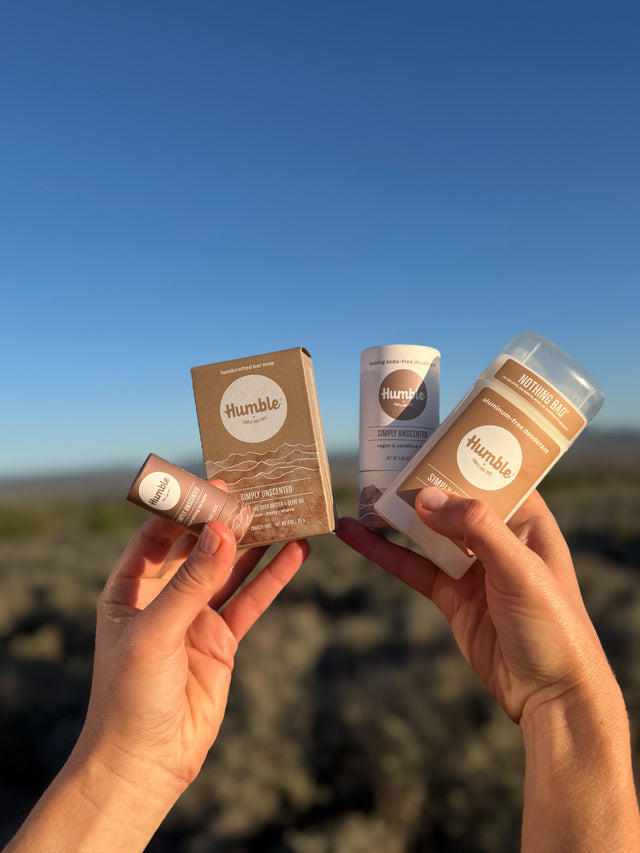
If you're starting with a fragrance-free formula, Humble's Simply Unscented Natural Deodorant is formulated without fragrance, baking soda, or aluminum, and it's a straightforward place to begin.
Unscented, alcohol-free options are often a sensible first step for sensitive skin, and this formula checks both boxes. It comes in a solid stick that gives you a warm, smooth application without the mess of a cream format.
Every Humble deodorant comes with a 60 Day Love-It Guarantee, so you can test it properly without risking a full-size commitment that goes wrong.
Related Reads


Most loved
Shop bestsellers

- Grounding
PLASTIC FREE DEODORANT
Black Spruce Plastic-Free Deodorant
$12.99
Scent intensity: 4/5


Leave a comment
Please note, comments must be approved before they are published